Bailly Cemetery, Westchester TownshipIndex of Bailly Cemetery burials . . . .
The Bailly Cemetery is located approximately three-quarters of a mile north of
the Joseph Bailly Homestead in Westchester Township, at the base of a sand
ridge in the center of the northeast quarter of Section 27 [click
here for detailed historical information concerning Bailly Cemetery]. It is the oldest
white burial ground in Porter County. It has been recorded that Joseph Bailly buried his son,
Napoleon B. "Robert" Bailly, here in
1827. It has also been recorded that Native Americans first used the site for
the burial of their dead. Though skeletons have been uncovered at the cemetery
site on numerous occasions, they have always been reburied without a
determination of their race. Hence, it has not been conclusively determined
whether the Bailly Cemetery was originally a sacred Indian burial ground.
After Napoleon B. "Robert" Bailly's burial in 1827, the site essentially became a family graveyard, although burials of individuals
unrelated to the Bailly's are numerous. For instance, it is known that several
Swedish residents of the area are buried in the cemetery in unmarked graves. In
addition, eight tombstones have been found outside and adjacent to the present
cemetery walls; four of these tombstones contain date inscriptions preceding Napoleon
B. "Robert" Bailly's date of burial in 1827. Given this evidence, it appears likely that
Joseph Bailly buried his son in a preexisting cemetery rather than establishing
a new cemetery site.
In 1866, Rose (Bailly) Howe, Joseph Bailly's daughter, enclosed the
cemetery area with a wooden fence. She specifically requested that her
neighbors, mostly being Swedish immigrants, to discontinue using the cemetery for
burials and to remove their dead relatives. Few neighbors apparently complied
with her request. In fact, during Rose (Bailly) Howe's absence on an extended
trip with her daughters to Europe between 1869 to 1874, at least three Swedish
immigrants are known to have been interred in the cemetery.
Reportedly distressed by the fact that her neighbors did not comply with her
requests concerning burials in the cemetery, Rose (Bailly) Howe had a six-foot limestone wall constructed on the site
in 1885,
topped with iron spikes. The inside of the wall included stations of the cross
placed inside wooden cabinets mounted in limestone, as well as
an altar at the southeast corner.
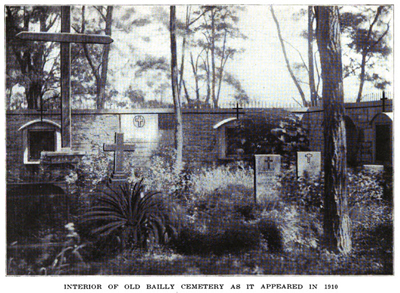
Bailly Cemetery, 1910, prior to the walled burial
ground being completely filled with sand (Bowers 1922).
In 1914, Frances Rose Howe, daughter of Rose, had Theodore Stephens of nearby Chesterton erect a concrete block wall around the 1867 wall to control entry into the cemetery. At this time stairs were erected on the north side of the cemetery and an ornamental railing installed on the original 1867 wall. The plaques installed in 1867 were moved from inside the wall to the outside of the wall, and the interior of the enclosed wall area was filled with sand. During the 1914 renovations and construction, numerous graves were uncovered and reportedly moved just outside of the new construction.
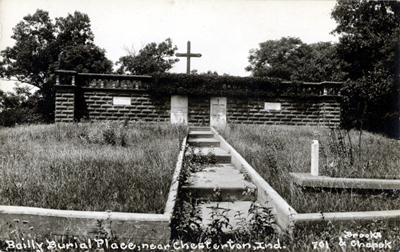
Bailly Cemetery, circa 1920s, after the walled burial
ground was filled sand in 1914 (Brooks and Chapek).
From a historical perspective, it should be noted that Frances Rose Howe's
attitude and behavior toward local residents was not harmonious, which may have
been an outcome associated with the Bailly Cemetery's use by individuals outside
her family. Interestingly, despite the Bailly family's historical significance
to Northwest Indiana, there are only brief mentions of the Bailly and Howe families published
in The Chesterton Tribune during the late 1800s and early 1900s,
overwhelmingly painting the family somewhat negatively. Other historical
evidence clearly supports the strained relationship between the Bailly/Howe
family and area residents. To illustrate, Frances Rose Howe writes in a letter dated December 27,
1915, to Caroline M. McIlvaine:
“Do you know a certain Dr. Herbert
(or Hubert) Skinner who
poses as a historian? He is too funny
for any use about our
family. He says ‘he has always taken
the greatest in our family.’
If so why has he never called at
Bailly Homestead. If I invite
him, he always want to plunge into a
wilderness of the Dismal
Swamp variety and come on horseback
through a net work of
Indian trails.”
- Chicago Historical Society Archives
Despite Frances R. Howe’s perception and general disregard for the historian,
Skinner was likely to have been keenly aware of the historical developments of
Porter County and an able writer of them. Mention of Skinner’s 1878 history is
made in the 1912 History of Porter County, Indiana, where it is written
that although the Skinner history is a “small work,” it “shows much careful
research and investigation.”
It is worthwhile to note that while Miss Howe was a granddaughter of one of
Porter County’s most prominent settlers, it is estimated that she spent much
less than one-half of her life in Porter County. Her family resided in Chicago
during her youth, where her father was a prominent banker. Miss Howe also
traveled extensively for long periods of time; for instance, she once toured
Europe and the Holy Land with her mother, Rose, and sister, Rose F., during her
youth for five consecutive years. She also maintained a winter residence in Hot
Springs, Arkansas.
Most notably, she was part of a much higher social class that
only a handful of Porter County residents could claim. In this regard, Frances
R. Howe was likely to be a very disconnected member of the general society and
culture of Porter County. In fact, as previously mentioned, it is documented
that animosity existed between local residents and the Howe family, and was
carried through for nearly a half-century after Frances Rose Howe's death. For
instance, the December 28, 1957, issue (page 2, column 7) of The
Vidette-Messenger, published in Valparaiso, Porter County, Indiana, quotes
Earl Reid of the Duneland Historical Society as stating:
"...old antagonisms toward the Bailly
family by old settlers is
gradually dying out, as the old
timers drop off, one by one.
Perhaps the present generation will
encourage a history of the
old [Bailly] family, without letting
minor irritations of pioneer days
influence their thinking. Of course
there is no doubt that the
Baillys did assume an upper bracket
status in the early days,
but that is a part of history, not an
excuse to bury the memory
of Porter county's first settler, who
came here with his
family in 1822."
Even Frances R. Howe's death notice, published in the January 24, 1917, issue of
The Porter County Vidette, suggests a rather clear disconnect between
Howe and the local community. Her death notice reads in part:
".... She has been away from her
Baillytown home for a
long time. She had built her own
chapel, in which she
worshipped, and her home was so
private that few of
the neighborhood ever saw its
interior."
The chain of title ownership of the land upon which the Bailly Cemetery is
situated is as follows:
| July 8, 1834 | Jacob Stair purchases land via government land patent |
| February 15, 1839 | Stair deeds land to Therese de la Vigne, Joseph Bailly's stepdaughter, after de la Vigne pays delinquent taxes on the property |
| 1856 | Joel Wicker, Joseph Bailly's son-in-law, acquires title |
| March 1864 | Rose (Bailly) Howe, daughter of Joseph Bailly, acquires title |
| 1891 | Frances Rose Howe, granddaughter of Joseph Bailly, acquires title upon her mother's death |
| 1917 (or 1921) | Carl Danielson purchases property upon Frances Rose Howe's death |
| 1949 | Carl Danielson deeds property to the Michigan City Historical Society |
| 1971 | United States government acquires title to the property |
Note that the information concerning burials in Bailly Cemetery is quite fragmented and
very likely to be incomplete and incorrect. The burial information provided
below originates from a variety of sources, including newspapers, National Park
Service information, published records of the Northwest Indiana Genealogical
Society, among others.
Three excellent sources of detailed historical information concerning the Bailly
Cemetery are the following [click link to access]:
Clemenson, A. Berle, Kenneth W.
Bennett, and Catherine H.
Blee. 1976.
Historic Structure Report, Bailly Cemetery:
Historical, Architectural, and Archeological Data, Indiana
Dunes
National Lakeshore, Indiana. United States Department
of the Interior, National Park
Service, Historic Preservation
Division. Denver, Colorado: United
States Department of the
Interior. 85 p.
Stephens, Theodore. 1956.
Bailly Cemetery - Roman Style.
Duneland Historical Society,
Living Biographies 2(4):1-6.
Sullivan, James R. 1958.
Historic Site Survey: The Bailly Homestead,
Porter
County, Indiana. Philadelphia, Pennsylvania: United States
Department of the
Interior, National Parks Service, Region
Five. 40 p.
NOTE: If you have information that you
like to add to this database, including corrections, then please contribute it
to
Steve Shook.
BAILLY, Joseph (Baptized Honoré-Gratien-Joseph Bailly de Messein)
Birth: April 7, 1774, in Varennes, Quebec, Canada
Death: December 21, 1835, in Chesterton, Porter County, Indiana
Note: Son of Michel Bailly de Messein and Geneviève Aubert de Gaspé; tombstone located on south wall of 20-foot by
20-foot elevated area.
BAILLY, Marie (LaFevre de la Vigne)
Birth: 1783
Death: September 15, 1866, in Chesterton, Indiana
Note: Aged 83y; tombstone located on south wall of 20-foot by 20-foot elevated
area; when Marie (LaFevre) Bailly died on Sept 15, 1866, Mrs. Emma Persson
prepared her body for burial while Emma's husband, Carl Persson, drove the
ox-cart which brought Marie's remains to "Bailly Hill" where she was laid to
rest by the side of her husband.
ERIKSON, Peter [or Erickson]
Birth:
Death: November 1862
Note: Civil War veteran; burial mentioned in report prepared by
C. W. Nelson in 1949. [The Bailly Cemetery. Manuscript in Reed Folder,
Indiana Dunes National Lakeshore Park.].
HOWE, Frances Rose
Birth: February 4, 1851
Death: January 20, 1917, Los Angeles, Los Angeles County, California
Note: Daughter of Francis and Rose (Bailly) Howe; never married, but did adopt
Emma Cecilia Bachmann in Chicago, Illinois, on September 26, 1904, when Emma was
23 years old. Died at the home of Emma Cecilia (Bachmann) Houston located in Los
Angeles, Los Angeles County, California, on January 20, 1917.
HOWE, Francis
Birth: January 8, 1811, in New Haven, Connecticut
Death: August 23, 1850, in Porter County, Indiana
Note: Husband of Rose Bailly; tombstone located on south wall of 20-foot by
20-foot elevated area.
HOWE, Rose (Bailly)
Birth: February 25, 1813, in Michigan Territory
Death: May 15, 1891
Note: Daughter of Joseph Bailly; wife of Francis Howe; tombstone located on
south wall of 20-foot by 20-foot elevated area.
HULT, Florinda
Birth:
Death:
Note: Aged 3m, 15d; daughter of Mr. and Mrs. Otto Hult; burial mentioned in
report prepared by
C. W. Nelson in 1949. [The Bailly Cemetery. Manuscript in Reed Folder,
Indiana Dunes National Lakeshore Park.]
HULT, Wilhelm
Birth:
Death:
Note: Aged 5y; son of Mr. and Mrs. Otto Hult; burial mentioned in report
prepared by
C. W. Nelson in 1949. [The Bailly Cemetery. Manuscript in Reed Folder,
Indiana Dunes National Lakeshore Park.]
LUNDEEN, Female Child
Birth:
Death:
Note: Daughter of William Lundeen; burial mentioned in manuscript prepared by
Theodore Stephens and published in 1956: "While I was working outside the north
wall, Mr. William Lundeen, who was standing nearby, pointed to a grave near the
foot of the stairs and said it was his little girl's grave, a young child of
three or four years. I didn't say anything at the time but later, I had the men
tear up the weeds, put a concrete low wall around the little plot and stood the
tombstones up straight in cement bases. He later said he was very glad I made it
so nice but the stone is now broken." [Stephens, Theodore. 1956.
Bailly Cemetery - Roman Style. Duneland Historical Society,
Living Biographies 2(4):1-6.]
MICHAELS, Frederick
Birth: April 27, 1829, in Bresslau, Germany
Death: December 23, 1884, in Porter Station [Porter], Indiana
Note: Obituary published in January 1, 1885, issue of The Tribune [Chesterton],
states that "He [Frederick] has a fine family vault in the
Baillytown cemetery, value about $1,000. . . . the remains of Frederick Michael
were laid in the family vault at the Bailly cemetery."
NORTEN, Augusta Charlotte (Peterson)
Birth: September 16, 1878, in Sweden
Death: January 8, 1902, in Porter County, Indiana
Note: Wife of Samuel Constans Norten, who is interred at Pine Lake Cemetery in
LaPorte, LaPorte County, Indiana.
STEPHENS, Magdelene
Birth: 1842
Death:
Note: Burial mentioned in report prepared by Theodore Stephens in 1956.
[Stephens, Theodore. 1956. "Bailly Cemetery - Roman Style," Duneland
Historical Society, Living Biographies 2(4):1-6.]
TAYLOR, Mrs. Edgar
Birth:
Death:
Note: Taylor's burial is mentioned in a newspaper article concerning historian
Thomas Harvey Cannon and Darius Blake, a descendant of Portage Township
pioneers. The article reads in part: Among the many manuscripts that he
[Cannon] left was one on Portage township, in Porter county, entitled "The
Recollections of Darius Blake," dated 1929. He quoted Blake as saying: "There
was only one instance of early day Indians being suspected of poisoning the
incoming settlers," said my grandfather Jacob Blake. He recollected a man named
Edgar Taylor told incoming home-seekers that he and his wife had been poisoned
by having been given 'doctored' fish by an Indian pretending friendship. The
wife died, and was buried in the outer area of the Bailly cemetery - and Taylor
abandoned his almost completed log cabin. "On Oct. 22, 1833, Jacob Blake and his
family arrived at the empty cabin. Tired out, and seeking shelter, they moved
in. From nearby Indians encamped at Bailly's Landing they learned that the
builder had abandoned it, and the land. So Jacob Blake took possession, and went
to the Government Land Office at Winamac to perfect his title." ["Manuscript
Tells of Portage," The Vidette-Messenger, Valparaiso, Porter County,
Indiana; October 16, 1958; Volume 32, Number 87, Page 1, Column 1 and Page 6,
Column 5]
WILLIAMSON, Hubert
Birth:
Death: 1855
Note: Williamson's burial is mentioned in a story concerning the first train to
pass between Michigan City, LaPorte County, Indiana, and Chicago and the Lake
Shore and Michigan Central Railway in 1855. Reportedly, Williamson was owner of
Green's Tavern at Tremont, Porter County, Indiana. A Native American named
Spotted Buck had entered Williamson's tavern and began helping himself to
alcohol behind the bar. Angry, Williamson struck Spotted Buck in the head with a
fireplace poker and the Indian dropped dead. Spotted Buck's death was soon
discovered and Williamson, who was already known by the county sheriff for other
misdemeanors, made an attempt to escape the area. Williamson boarded the
westbound train at Tremont, but the train derailed near Baillytown. Williamson
was killed by the derailment. The article reads in part: Somehow, in
one of those cases of co-incidences, the train struck an ill-made bit of track
at the vicinity of Baillytown. The rails spread, the train was derailed with an
emphatic jerk, and the only person injured was the fugitive, Hubert Williamson,
who was thrown against an obstruction and killed.... Thomas G. Lytle was the
sheriff in 1855, Ruel Starr was one of the commissioners, and Sylvester Smith
was the auditor. The county records of that year show a remuneration to John
Lunberg for coffin and burial of a man named Williamson, killed in a train wreck
at Baillytown. The burial was apparently in a cemetery at Baillytown, and a Rev.
French, officiated." ["New Train is Delayed in County," The Vidette-Messenger, Valparaiso, Porter County,
Indiana; July 11, 1957; Volume 31, Number 6, Page 1, Column 1 and Page 6,
Column 1]
Other Bailly Family Burials
There are reportedly an additional
twelve Bailly family interments in the cemetery, but no tombstones can be found
for these burials.
BAILLY, Napoleon B. "Robert"
Birth: April 1816, Drummond Island, Canada [now Chippewa County, Michigan]
Death: September 1827
Note: In a book published by Frances Rose Howe [The Story of a French Homestead
in the Old Northwest,
1907, pp. 68-69], it is stated that "He [Joseph Bailly] had chosen a
spot for a cemetery on a sandy knoll, about three-quarters of a mile from the
house. there he had buried his son [Robert] and had raised a huge cross
of oaken beams as a landmark. In front of this cross, he erected a little log
building where the only opening was a rather wide door, facing the cross. This
building was not a chapel, but merely a shelter for those who went to pray at
the foot of the cross, as did all the household on Sundays and Holy Days."
In a book published by John O. Bowers [The Old Bailly Homestead, 1922, p. 6], it
is stated that "In 1827, while attending the Carey Mission school, near Niles
[Michigan], Robert Bailly, the son, then 10 years old, became sick with
typhoid fever and died. His grave was the first in the family cemetery, located
a half a mile north of the old homestead."
de la VIGNE, Mary Therese
Birth: October 13, 1808
Death: December 17, 1867
Note: Daughter of Marie (LeFevre de la Vigne) Bailly by her first marriage. This
burial is enumerated in the National Park Service's Historic Structure
Report, Bailly Cemetery: Historical, Architectural, and Archeological Data,
Indiana Dunes National Lakeshore, Indiana, prepared by A. Berle Clemensen,
Kenneth W. Bennett, and Catherine H. Blee and published in December 1976. The
report states that Therese de la Vigne died in 1843, though no source is
provided as evidence. However, David Frederick, a Bailly descendant, has
provided ample evidence to show that Mary Therese de la Vigne was buried in
Uniontown Cemetery located in Willard, Shawnee County, Kansas. He reports the
following: "She [Mary Therese de la Vigne] used several names in her lifetime.
Her birth name was Mary Therese Lavigne, her Pottawatomie name was Terrez. In
her early years, she most often used the name Therese Bailly. Contrary to her
portrayal in Francis Howe's book and other accounts, she attended Carey Mission
longer than any of the other Bailly children and was an outstanding scholar. At
the mission, she was given the name Martha Shields. She attended Worthington
College in Ohio. In 1830, she married Peter Nadeau, with her mother Marie Bailly
serving as witness. The name given for the marriage record was Mary Rousseau.
She and her husband took over Joseph Bailly's trading concession with the
Nottawasseppe Pottawatomie village near current Mendon, St. Joseph County,
Michigan. They had two sons and two daughters. A notarized affidavit by her son
Eli G. Nadeau is in the collection of the Oklahoma State Historical Society
which asserts that the small Nadeau children spent a great deal of time with
their grandmother at the Bailly homestead. She and her husband sold their
Michigan land in 1836 and returned to Indiana. Mary Therese was a full member of
the Pottawatomie of the Prairie tribe, and accompanied, or was part of, the
"Trail of Death" forced march from Indiana to Kansas in 1839. She traded with
the Pottawatomie in association with her brother-in-law John H. Whistler and his
brother-in-law Robert A. Kinzie (his sister's husband). She was already living
at the town site of Uniontown, Shawnee County, Kansas when the town sprung up in
the 1840's. The town faded rapidly, but she remained; dying on December 17,
1867. Her daughter Mary L. Bourassa, three grandchildren, and her daughter's
stepson are also buried in Willard Cemetery."
HOWE, Eleanor
Birth:
Death:
Note: Infant daughter of Francis and Rose (Bailly) Howe. This burial is
enumerated in the National Park Service's Historic Structure Report, Bailly
Cemetery: Historical, Architectural, and Archeological Data, Indiana Dunes
National Lakeshore, Indiana, prepared by A. Berle Clemensen, Kenneth W.
Bennett, and Catherine H. Blee and published in December 1976.
HOWE, Frank
Birth:
Death:
Note: Infant son of Francis and Rose (Bailly) Howe. This burial is enumerated in
the National Park Service's Historic Structure Report, Bailly Cemetery:
Historical, Architectural, and Archeological Data, Indiana Dunes National
Lakeshore, Indiana, prepared by A. Berle Clemensen, Kenneth W. Bennett, and
Catherine H. Blee and published in December 1976.
HOWE, Infant Daughter
Birth:
Death:
Note: Infant son of Francis and Rose (Bailly) Howe. This burial is enumerated in
the National Park Service's Historic Structure Report, Bailly Cemetery:
Historical, Architectural, and Archeological Data, Indiana Dunes National
Lakeshore, Indiana, prepared by A. Berle Clemensen, Kenneth W. Bennett, and
Catherine H. Blee and published in December 1976.
HOWE, Infant Son
Birth:
Death:
Note: Infant son of Francis and Rose (Bailly) Howe. This burial is enumerated in
the National Park Service's Historic Structure Report, Bailly Cemetery:
Historical, Architectural, and Archeological Data, Indiana Dunes National
Lakeshore, Indiana, prepared by A. Berle Clemensen, Kenneth W. Bennett, and
Catherine H. Blee and published in December 1976.
HOWE, Rose
Birth: 1842
Death: 1879
Note: Daughter of Francis and Rose (Bailly) Howe. This burial is enumerated in
the National Park Service's Historic Structure Report, Bailly Cemetery:
Historical, Architectural, and Archeological Data, Indiana Dunes National
Lakeshore, Indiana, prepared by A. Berle Clemensen, Kenneth W. Bennett, and
Catherine H. Blee and published in December 1976.
WHISTLER, Mary Esther (Bailly)
Birth: July 27, 1811, Michilimackinac, Michigan Territory
Death: January 29, 1842, in Baillytown, Indiana
Note: There is no known tombstone to exist for Mary Esther (Bailly) Whistler in
the Bailly Cemetery. In a book published by her niece Frances Rose Howe [The
Story of a French Homestead in the Old Northwest, 1907, p. 148], it is stated that "I remember
that Aunt Hortense died when I was about five years old, and that her remains
were brought here [Baillytown] from Chicago, to be laid beside Aunt
Esther." However, it is believed by Bailly family descendants that Aunt
Hortense was buried in Chicago, Illinois, which would suggest that Mary Esther
(Bailly) Whistler was also buried in Chicago. In the same book mentioned above,
it is stated [pp. 136-137] that "The next time she [Rosene Marie Victoire
(Bailly) Howe] entered her old home, just a few months later, it was to see
her dear sister Esther laid in a grave at the foot of the old oak cross. Uncle
Whistler was wild with grief and could not endure to remain, where everything
reminded him of his bereavement. He had a good opportunity of beginning life
anew in Kansas, and taking his four boys with him, went there, severing himself
entirely from all that could recall to mind the days of a vanished happiness."
WICKER, Josephine Hortense (Bailly)
Birth: Circa 1819, Michilimackinac, Michigan Territory
Death: 1855, in Chicago, Cook County, Illinois
Note: There is no known tombstone to exist for Josephine Hortense (Bailly)
Wicker in
the Bailly Cemetery. In a book published by her niece Frances Rose Howe [The
Story of a French Homestead in the Old Northwest, 1907, p. 148], it is stated that "I remember
that Aunt Hortense died when I was about five years old, and that her remains
were brought here [Baillytown] from Chicago, to be laid beside Aunt
Esther." However, it is believed by Bailly family descendants that Aunt
Hortense was buried in Chicago, Illinois.
UNKNOWN
Birth:
Death:
Note: Two nephews of Francis and Rose (Bailly) Howe. These two burials are
enumerated in the National Park Service's Historic Structure Report, Bailly
Cemetery: Historical, Architectural, and Archeological Data, Indiana Dunes
National Lakeshore, Indiana, prepared by A. Berle Clemensen, Kenneth W.
Bennett, and Catherine H. Blee and published in December 1976.
The McDonald Tombstones
The 1876 plat map of Porter County
indicates that Henry R. McDonald owned at least 900 acres of land in the
Furnessville area of Westchester Township. Henry married Martha (Wilson)
McDonald in 1830 and settled in the Furnessville area around 1832. Henry and
Martha were the parents of Charles, Martha, Fanny, Lynn, Abbie, Henry, Mary,
Sidney, and Elixa. The tombstone for Eliza and Sidney were discovered on the
back of the McDonald farm and reportedly removed to Bailly Cemetery.
McDONALD, Eliza
Birth:
Death: July 16, 1864
Note: Aged 9y; daughter of H. D. and Martha McDonald
McDONALD, Sidney
Birth:
Death: March 4, 1862
Note: son of H. D. and Martha McDonald
Tombstones Warehoused by National Park Service
The following tombstones are reportedly in storage at the Indiana Dunes National Lakeshore
warehouse at the park headquarters. It is believed that these
tombstones represent individuals interred in the Bailly Cemetery.
BERGSTROM, F. Louisa (Johnson)
Birth: January 10, 1829, Sweden
Death: January 10, 1873
Note: Aged 43y, 3m, 9d; wife of Frank Bergstrom
CARLSON, Peter
Birth: April 11, 1814, in Sweden
Death:
Note: bottom half of tombstone is missing
DEMPSEY, Lewis
Birth:
Death: February 25, 1854
SCHELLINGER, Isaac
Birth:
Death: August 1811
Note: Aged 67y; year of death may be 1841 or 1844
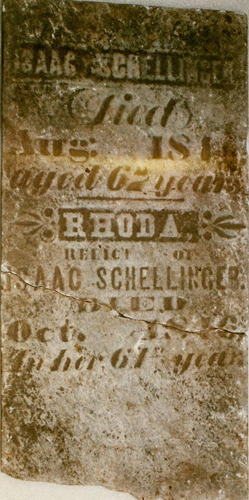
Schellinger tombstone housed at the Indiana
Dunes National Lakeshore (Eva Hopkins).
SCHELLINGER, Rhoda
Birth:
Death: October 1816
Note: Aged 61y; year of death may be 1846
SPEER, Thomas B.
Birth:
Death: June 30, 1817
Note: Aged 3y, 6m; son of J. and E. Speer; year of death may be 1847
UNKNOWN,
Birth:
Death: February 6, 1875
Note: tombstone broken and pieces missing
The following article concerning the Bailly Cemetery appeared in the June 12,
1913, issue of The Chesterton Tribune, Chesterton, Porter County, Indiana
[Volume 30, Number 12, Page 1, Column 2]:
A HISTORIC SPOT.
Remains of Early French Days Attract Considerable Attention
Michigan City News: Anent the old French chapel and graveyard near Porter,
visited this week by St. Cecelia's Guild of Trinity cathedral, as mentioned by
The News, the Gary Evening Post says:
Very few people living in Gary are aware that within twelve miles of Broadway is
one of the most historic spots in the middle west. It is the old French-Indian
village and burying ground, used by the mission explorers, and is older than
Chicago.
Situated upon a steep ridge overlooking the old Detroit trail and within a few
hundred yards of the South Shore interurban line, two miles northwest of Porter
is the old cemetery, surrounded by a high stone wall and filled with a profusion
of vines and other forest growth. In niches around the inside wall are many
pictures of saints, which are in a good state of preservation, but the
tombstones are falling down and many of them are covered with fallen leaves that
have accumulated for years. Nearby is the old log French chapel used by the
early fathers when they passed through the country on their journeys from
Detroit to the French settlements along the Illinois and Mississippi river.
The old burying ground is said to have been used for the same purpose by the
Indians long before the white man penetrated the wilderness.
The oldest tombstone in the stone-walled cemetery records the date of the death
of a white man in 1812, which was one hundred and one years ago.
The old cemetery is difficult of access. A representative of the Evening Post
scrambled up the hill through a jungle of undergrowth to find the cemetery gate
barred and overgrown with vines and briars. He found himself in the past - a
past that spoke of dim Indian trails, of mission fathers, of the times when the
French flag floated over the great lakes region and when few white men, aside
from the French missionaries had set foot in the region around the foot of the
lake.
Several of the rude stones mark the last resting place of mission fathers of the
church. Here they worked among the Indians and here they died, martyrs to the
cause they loved. One was tempted to recite the couplet by Robert Louis
Stevenson:
"Round about the grave or martyrs the whaups are crying;
My heart remembers how."
Michigan City folk have also discovered the old cemetery in the sand dunes and
wilderness.
The following death notice for Frances Rose Howe appeared in the January 24,
1917, issue of The Porter County Vidette, Valparaiso, Porter County, Indiana
[Page 5, Column 1]:
MISS HOWE IS CALLED BY DEATH
Miss Frances Howe, the last descendant of Joseph Bailly, first white settler
of Porter county, who founded Baillytown, Westchester township, in the pioneer
days, died last Saturday at the home of her adopted daughter, Mrs. Houston, in
Los Angeles, Cal. The body will be brought to Chesterton, and the funeral will
be held in the private chapel built by Mrs. (sic) Howe. Her body will be laid to
rest in the famous old burying ground on which she spent thousands of dollars
for its refinement and preservation. It is walled in, and the crypts, the
monuments, and the engravings there are works of the highest art.
The cause of Miss Howe's death is not known here, but some believe it was
apoplexy. She had been away from her Baillytown home for a long time. She had
built her own chapel, in which she worshipped, and her home was so private that
few of the neighborhood ever saw its interior. Miss Howe was about 69 years old.
The following newspaper item concerning the burial of Frances Rose Howe appeared in the
February 7,
1917, issue of The Porter County Vidette, Valparaiso, Porter County, Indiana
[Page 2, Column 3]:
BODY OF MISS FRANCES HOWE COMING IN TWO WEEKS
(From Friday's Daily)
George Battieger, of Chesterton, who was in town today, received a letter this
morning from Mr. and Mrs. James L. Houston, of Los Angeles, stating that not for
two weeks yet will they leave there for Chesterton with the body of Miss Frances
Howe for interment in the Bailley burying ground on the Howe homestead. Mrs.
Houston, adopted daughter of Miss Howe, has been suffering with an illness that
caused the delay.
The following newspaper item concerning the burial of Frances Rose Howe appeared in the
February 21,
1917, issue of The Porter County Vidette, Valparaiso, Porter County, Indiana
[Page 6, Column 5]:
LOCAL SQUIBS AND PERSONALS
The body of Miss Frances Howe arrived in Chesterton today from Los Angeles,
where she died a month ago. Interment will be in the private cemetery of the
Bailly family.
A THREE ACRE PLOT, PORTER COUNTY'S OLDEST BURIAL SPOT CAUSE OF BITTER COURT
ACTION
Descendants of Historic Family That Founded Baileytown, Started in 1822, Seek
to Restrain New Owners of Property in Which Cemetery is Located from Violating
Pact
SACRED PATH NOW USED AS PASTURE
(By ENGLEBERT ZIMMERMAN)
Historic Baileytown, in Westchester township, founded in 1822 by Joseph Bailey
or Bailly, is now the battleground in a legal action filed in Porter circuit
court in which a restraining order granted without notice by Judge Grant
Crumpacker against Carl John and Antonia Danielson.
Representing the plaintiffs, many in number, is James J. McGarvey, deputy
prosecuting attorney of Porter county, and the youngest member of the local bar.
They are Raymond Larson, Emil Peterson, Nels Samuelson, Carl Samuelson, Emily
Borg, Nellie Linden, Emma Peterson, Charles Chelberg, Minnie Chelberg, William
Linden, Conrad Carlson, Alfred Borg, Clara Samuelson, Charles Johnson, Julia
Borg, Sophia Carlson, Esther Swanson, Anton Bandur, John Harbrecht, Fred Sievert,
Gus Schultz and Otto Peterson.
The Baileytown cemetery, known as the Howe or Old Indian burying ground, is the
focal point in the controversy which has stirred up a strong protest in north
Porter county and transformed that section into a hostile camp. A little three
acre patch of land is the cause of agitation for within its sacred confines many
white people who were pioneers of this region when it was the western frontier
of the United States are buried. Monsieur Bailly, his grandmother, Frances Howe,
and members of an extinct tribe of Indians which roamed this territory when the
Spanish commander, Don Eugenio Pierre, came from St. Louis, followed the Old Sac
trail through Valparaiso and then northward to Baileytown, are interred in the
city of the sleeping dead.
For eleven years Joseph Bailly was the only white inhabitant in Porter county.
He had established a store and built up a considerable trade with the Indians.
His influence over the natives was unbounded, and his traffic in furs yielded
him an almost princely revenue. He married an Indian woman, said to have been
the daughter of a famous chieftan [sic], and was thoroughly acquainted with the
habits, customs and language of her people.
The settlement of Baillytown became widely known: travelers, traders,
adventurers, missionaries and government officers made it their rendezvous. It
was the leading place of assembly for religious exercises; it was an important
center of trade; it was a place of safety in time of danger. Mr. Bailey
purchased a sloop in order to navigate the great lakes, and gave his daughters
the advantages of travel and an eastern education.
The Danielsons acquired the farm in which the burial ground is located in 1921
by virtue of a deed from Emma C. Huston, daughter of Mrs. Howe, and her husband,
James L. Huston, living at Los Angeles, California. In the deed on file in the
county recorder's office, and made a part of the complaint, the grantors
dedicated a certain part of the real estate, namely: the three acres containing
the cemetery, as a place to be kept sacred as a burial ground, stipulating that
in no event that it be used for farming purposes, but on the other hand
expressly stating that parties having friends and relatives buried there be
given the privilege of ingress and egress for the purpose of visiting the
grounds and making any necessary repairs for the preservation of the grounds,
tombstones and monuments.
The plaintiffs allege the defendants have not kept the burial ground sacred.
They charge that they allowed cattle to graze on the premises, defaced and
destroyed the monuments, removed fences and water pipes, permitted it to be used
as a playground, posted signs forbidding entry by any person, and interferred
[sic] with the ingress and egress of persons having relatives and friends buried
there.
It is averred by the plaintiffs that they have been greatly damaged and
considerable anguish has been caused to them by the acts of the defendants. They
also set out that much in the way of interesting data in the cemetery which has
attracted many persons by reason of its historical significant has been
obliterated and destroyed.
Hearing on the temporary injunction against the defendants was set down for next
Monday by Judge Crumpacker. If a ruling is favorable to the plaintiffs, trial on
the permanent injunction will be taken up at the September term.
The following article concerning the Bailly Cemetery appeared in the August 24,
1927, issue of The Vidette-Messenger, Valparaiso, Porter County, Indiana
[Volume 1, Page 1, Column 3, and Page 3, Column 3]:
COURT BALKS ON ISSUING OUTER WRITS
Two restraining orders, granted Westchester township residents, have been
dissolved by Judge Grant Crumpacker in Porter circuit court Monday and Tuesday.
Both had been issued without notice to the defendants.
One involved the historic old Baileytown cemetery, where are interred the
remains of Joseph Bailly, the first white settler of Porter county, his
daughter, Rose Bailly, and granddaughter, Frances Rose Howe, besides a number of
Indians who once roamed the broad and fertile acres of north Porter county.
In the Baileytwon case, a score of plaintiffs, who have relatives and friends
buried adjacent to the Howe cemetery, sought to enjoin the Danielsons from
desecrating the last resting place of their kin. It was claimed that the
Danielsons had permitted cattle to graze in the grave plots, and committed other
acts in violation of an agreement in the deed to the property when it was
purchased by them of the Hustons, former owners.
Testimony adduced at the hearing yesterday brought out he fact that the persons
claimed to be buried in the Howe cemetery, are in reality, interred on the
outside of the stone wall, marking the boundary of the historic grave yard.
There was no evidence of any graves by way of markers, and the testimony
discloses that the last interment, that of a child of an employe of Howes, took
place thirty-five years ago.
The ruling of Judge Crumpacker in favor of Danielsons was on the theory that
they were innocent purchasers and had no knowledge that the cemetery existed
outside the walls of the Howe plot. The chain of title also showed no such
notice to the defendants.
It was the opinion of the court hat the plaintiffs had slept on their rights and
should have taken action many years ago before the alleged desecration of the
cemetery took place.
It was brought out through testimony of Danielson that he had entered into a
constrast [sic] with the Sisters of Notre Dame to give them the part of the
cemetery within the walls where lie the remains of the county's earliest
pioneers. It is also expected that persons having relatives outside the walls
will be allowed to erect tablets within the enclosure to show that their
ancestors are buried in the immediate vicinity.
The restraining order against the Northwestern Indiana Telephone company was
dissolved by Judge Crumpacker who held that the company was entitled under its
franchise to erect poles and string wires in any alley or street in the town
under the supervision of the town board. The court ruled that the company did
not have to secure the consent of property owners. Two cases were brought
against the telephone company to prevent it erecting poles and wires. John
Johnson and Harry Smith brought one action, and Attorney George R. Williams and
several others the second action. Attorney Williams acted as counsel for all.
The following article concerning the Bailly Cemetery appeared in the November 11,
1927, issue of The Vidette-Messenger, Valparaiso, Porter County, Indiana
[Volume 1, Page 1, Column 1]:
COURT RULING ENDS HISTORIC CEMETERY SUIT
Judge Crumpacker Dismissed Injunction Action to Halt Desecration of
Baileytown Burial Ground.
JOSEPH BAILEY PLOT PROTECTED BY DEED
Cattle may be permitted to graze unmolested over historic Baileytown cemetery,
overlooking Dunes Hiway [sic], save where a deed protects the small stone
surrounded burial plot of Joseph Bailly, Porter county's first white resident
and members of his family.
Yesterday in Porter circuit court, Judge Grant Crumpacker dismissed the
injunction case brought by a number of residents in north Porter county
represented by Attorney James J. McGarvey, when the plaintiffs did not appear to
fight the desecration of the cemetery which links the county with the pioneer
days of the state.
Some time ago Judge Crumpacker dismissed a temporary restraining order granted
without notice and refused a temporary injunction because the cemetery,
established in 1832, was not registered and because the deed to the land
purchased by Carl and Antonia Danielson, its present owners, lists only the
stone-enclosed burial ground.
The little burial ground on the crest of a slope overlooking the Dunes Hiway,
includes a small plot walled in by stone and surmounted by a tall cross -- the
resting place of Joseph Bailly and members of his immediate family.
There re other buried there in the three acres surrounding the area with its
weather-beaten stone, but there are not tombstone over their graves, evidence
which caused the court to rule the Danielsons were "innocent purchasers" in
refusing the injunction pleas.
The Danielsons, however, have kept the premises outside the Bailey plot in fine
condition, despite the allegations made that desecrations of a wholesale
character were being perpetrated.
For eleven years Joseph Bailly, who came to Porter county in 1822, was the only
white settler in Porter county. In his trading relations he built up a close
friendship with the Indiana tribes and married the daughter of an Indiana
chieftan [sic].
His old homestead, with its various buildings, in Old Baileytown, south of the
Dunes Hiway, still remain, and are being perpetuated as a pioneer settlement by
the Sisters of Providence, or Notre Dame, Milwaukee, Wisc.
The following article concerning the Bailly Cemetery appeared in the February 8,
1949, issue of The Vidette-Messenger, Valparaiso, Porter County, Indiana
[Volume 22, Number 183, Page 1, Columns 1 and 2]:
County Landmark Is Bought By Michigan City Society
A landmark of Porter county's early history, the Joseph Bailly family cemetery,
at Baillytown, northwest of Chesterton, has been purchased by the Michigan City
Historical society.
President W. H. Vail, of the society, Monday announced the acquisition and said
that a deed to the property will be recorded in the Porter county recorder's
office in Valparaiso.
It was announced that the society eventually plans to turn the cemetery over to
the state conservation department as a memorial. Society officials expect to
recommend its annexation to Dunes State park, it was said.
The Michigan City society, which reorganized three years after 18 years of
inactivity, has been interested in the site for some time. Bailly's wife was a
half Ottawa Indian while he was a French-Canadian and one of America's biggest
fur traders, with operations covering the upper Mississippi valley from Mackinac
to New Orleans.
The cemetery has stone tablets in the walls with lists of those buried there.
Temporarily the previous owners will act as custodians for the society.
The following article concerning the Bailly Cemetery appeared in the July 29,
1972, issue of The Vidette-Messenger, Valparaiso, Porter County, Indiana
[Volume 46, Number 22, Section II, Page 14, Columns 1-4]:
Rollie Bernhart's Sombody, Or Something
In 1905, while picking berries in the Westchester Township near the historical
homestead and trading post of Porter County's first white settler, Joseph
Bailly, a group of Valparaiso children spotted an attractive cemetery.
Miss Ethel Ruth, 43 Monroe, a retired teacher, recalled that she was with a
sister and brother on a weekend countryside tour with their parents when they
stumbled upon the burial plot. "It was surrounded by a wall and an iron gate,"
she remembers. "We climbed the fence to see what was inside."
She said she vividly remembers the old-fashioned gravestones identifying members
of the Bailly and Howe families, and Indian chiefs. Also there were Stations of
the the Cross along the edges of the wall.
Miss Ruth said in later years, during her tenure of teaching at Chesterton High
School, she had an opportunity to visit the cemetery area, only to find it
completely buried by a high mound of earth. Recalling the impressive appearance
of the family spot some 60 years ago, she would like to see it restored for
posterity.
A check with a member of the Duneland Historical Society, Miss Margaret Larson,
of Chesterton, disclosed that National Lakeshore officials have been approached
to refurbish the burial plot, located less than a mile north of the homestead.
Now a historical national shrine, the property is under the jurisdiction of the
National Lakeshore.
She said she had contacted men connected with renovation of the homestead,
trading post buildings and surrounding land including the cemetery. Miss Larson
was told the cemetery is being considered in restoration plans for the shrine,
but how it will be done has not yet been decided.
What happened to the beautiful cemetery seen by Miss Ruth, her sister and her
brother during the berry picking tour of Westchester Township?
According to Miss Larson, and for reasons unknown, Frances Howe, a granddaughter
of the pioneer settler, had a concrete block wall erected around the burial
plot, covered the stones with sand and gravel, and added a topping soil in the
shape of a burial mound. Miss Larson estimated this was done about 1912, but
could offer no reason why the cemetery was buried except the supposition that
the Bailly descendant probably felt it was the best way to preserve it.
When Frances Howe died, her body was interred atop the mound. A cross marked the
spot, which could be seen from Old Chicago Road before the marker was vandalized
and desecrated.
Not too long ago, Miss Larson said she took a group of fifth graders on a tour
of the homestead and tried to battle the high brush to get to the burial mound.
"We were unsuccessful, but it apparently wasn't impossible to persons bent on
destroying the Cross which marked the grave."
She said her mother told her on many occasions how beautiful the cemetery was
with its wrought iron fence and wrought iron seats where the Bailly-Howe
families often went to meditate and pray.
Like Miss Ruth, she would like to see the family burial plot restored together
with the rest of the historical momentos [sic] of the days when Joseph Bailly
came to the spot along the Little Calumet River in Westchester Township and
founded the trading post and built the huge main house which are now in the
National Lakeshore.
Should it be left as it now is and just clean up the land around it? Or, should
the fill be removed and the burial plot restored as it was in the early 1900s?
There are some who would like it completely restored. The Lakeshore officials
are undecided. What is the popular opinion?
Bailly Cemetery data prepared by Steven R. Shook